Confessions of a Funeral Director by Caleb Wilde
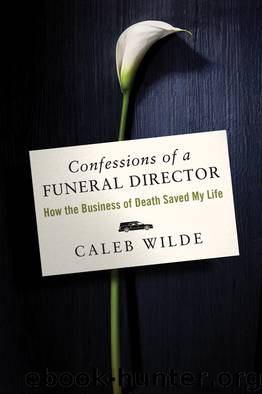
Author:Caleb Wilde
Language: eng
Format: epub
Publisher: HarperCollins
Published: 2017-08-11T04:00:00+00:00
11
SARA’S MOSAIC
It was six in the morning.
My grandfather and I drove up to the house, and an uncle of the deceased was standing outside with a cigarette in hand, ready to meet us and guide us into the house.
“You guys are here for my niece, Sara.”
He took a deep drag from his half-smoked cigarette, blew smoke into the crisp morning air, and explained that Sara was eight years old and had been fighting cancer for four years.
“She’s in the living room with her mother, Joan. Follow me,” he said.
We entered the house, walked into the living room, where about twenty family members and friends were scattered all over—some sitting, and some standing, others lying on the floor. Some of the people in this room were connected not by blood, but by the progressive growth of abnormal cells and the shared struggle those cells create. Cancer has a way of creating a hodgepodge community that isn’t connected by church or sports or club memberships, but by struggle, pain, and chance meetings in children’s hospitals.
My grandfather made his way around the room hugging all who were willing. And I took the logistical job of surveying the room and determining how we were going to do our job of wheeling a stretcher into this people-packed space and removing Sara back to the van. As I surveyed, I noticed a very startling fact: I didn’t see Sara.
When a terminal person is dying under home hospice care, as Sara had, sometimes hospice sets up the temporary hospital bed in the living room of the first floor, enabling larger groups to visit the dying. It’s the little things that hospice does that make death and dying a little graceful, especially for us funeral directors and our backs. Having people die on the first floor is so much easier than having them die like Jack McClure, who had the nerve to pass away in his sixth-floor apartment on the exact day the elevator was being repaired.
Although Sara’s bed was set up in the living room, she wasn’t lying on it.
Unlike some families, who just want us to come to the house, take away their dead, and do our job, Sara’s family and friends wanted to explain to us who Sara was, what she meant to them. It was important for them to tell the stories, to believe that through their stories of Sara—concise as they were at 6 A.M.—she could be incarnated in us so that we could love her, too, and become proxy family. They told us how she’d encourage her fellow cancer patients at the hospital, making them cards and always sharing her beloved Hershey Kisses. How she’d always manage to find a smile even in the darkest of times. They talked about her desire to die at home and how, in her final days, she was even concerned about her family’s ability to cope after she died. There was something endearing about the way they told the stories, about how they talked about Sara, and about how real they made her feel to us, complete strangers.
Download
This site does not store any files on its server. We only index and link to content provided by other sites. Please contact the content providers to delete copyright contents if any and email us, we'll remove relevant links or contents immediately.
| Anthropology | Archaeology |
| Philosophy | Politics & Government |
| Social Sciences | Sociology |
| Women's Studies |
Nudge - Improving Decisions about Health, Wealth, and Happiness by Thaler Sunstein(7692)
The Fire Next Time by James Baldwin(5431)
iGen by Jean M. Twenge(5408)
Adulting by Kelly Williams Brown(4566)
The Sports Rules Book by Human Kinetics(4379)
The Hacking of the American Mind by Robert H. Lustig(4375)
The Ethical Slut by Janet W. Hardy(4242)
Captivate by Vanessa Van Edwards(3838)
Mummy Knew by Lisa James(3686)
In a Sunburned Country by Bill Bryson(3537)
The Worm at the Core by Sheldon Solomon(3486)
Ants Among Elephants by Sujatha Gidla(3461)
The 48 laws of power by Robert Greene & Joost Elffers(3247)
Suicide: A Study in Sociology by Emile Durkheim(3018)
The Slow Fix: Solve Problems, Work Smarter, and Live Better In a World Addicted to Speed by Carl Honore(3007)
The Tipping Point by Malcolm Gladwell(2914)
Humans of New York by Brandon Stanton(2868)
Handbook of Forensic Sociology and Psychology by Stephen J. Morewitz & Mark L. Goldstein(2704)
The Happy Hooker by Xaviera Hollander(2686)
